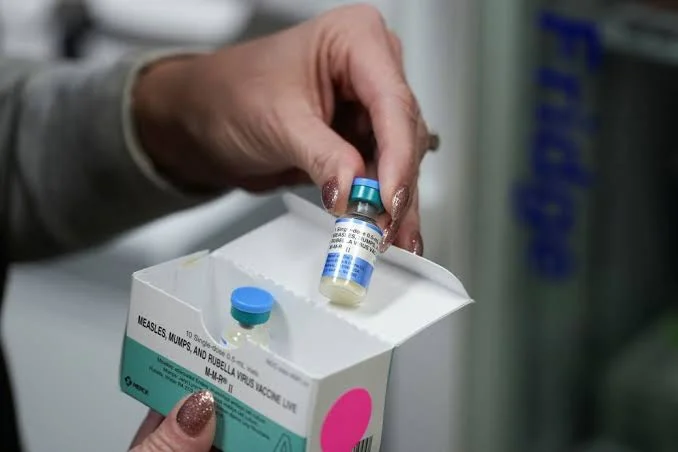
The United States has lost its measles elimination status after an independent commission of the Pan American Health Organization (PAHO) determined that the virus had circulated continuously within the country for more than 12 months.
PAHO announced the decision on Tuesday, November 17, reversing the elimination status the US achieved in 2000. The commission also ruled that Mexico and Bolivia had lost their measles elimination status.
“Losing a measles elimination status has broader implications than losing a public health designation,” PAHO Director, Dr Jarbas Barbosa, said during a media briefing.
“It means the virus has circulated for a prolonged period of time, putting families and communities at risk of a preventable illness, hospitalization and death,” he added.
More than 5,400 measles cases have been reported in the US this year, more than twice the previous year’s total and the highest annual figure since 1991. State health departments have also recorded 10 deaths, including at least four infants who were too young to receive routine measles vaccination.
Dr Richard Besser, president of the Robert Wood Johnson Foundation, described the development as a distressing setback for public health.
“As a pediatrician and a parent, I am heartbroken that we have reached this point,” he said.
“Too many families in America are once again having to worry that their children could get this preventable infection and suffer its most severe consequences.”
The eight-member PAHO commission met for four days in Washington last week to examine evidence of sustained measles transmission between January 2025 and January 2026.
Its assessment included genetic analysis of infections not linked to international travel to determine whether outbreaks across different states were connected. The experts also reviewed vaccination coverage, disease surveillance systems and the availability of resources and strategies to control outbreaks.
The loss of elimination status comes amid declining childhood vaccination rates in the United States.
About 92 per cent of kindergarten pupils received the measles vaccine during the 2025–2026 school year, down from 95 per cent in 2019–2020. Health authorities identify 95 per cent vaccination coverage as the threshold needed to prevent widespread outbreaks.
An NBC News investigation found that 75 per cent of counties and jurisdictions with available kindergarten vaccination data had coverage below the recommended level.
“The United States has an extraordinary measles problem. We’ve had more measles cases in the last 18 months than we’ve had in the previous 25 years combined,” said Noel Brewer, a public health professor at the University of North Carolina at Chapel Hill.
Dr Walter Orenstein, a former director of the US immunisation programme at the Centers for Disease Control and Prevention (CDC), warned that continued transmission posed particular risks to people who were not vaccinated.
Infants typically receive their first routine measles vaccine dose at 12 months, while some individuals with weakened immune systems cannot receive the vaccine.
“People can go into a supermarket and get infected,” Orenstein said.
In some areas experiencing outbreaks, health departments have recommended an early vaccine dose for infants as young as six months.
Measles is one of the most contagious infectious diseases, capable of spreading to nine out of 10 susceptible people exposed to an infected individual. The virus can remain airborne for up to two hours and cause serious complications, including pneumonia and brain swelling.
Brewer called for a stronger national response, describing the government’s handling of the growing outbreak as inadequate.
“The lack of action to address the growing outbreak is clear negligence,” he said.
He noted that previous administrations had used CDC media briefings and vaccination campaigns to respond to measles outbreaks, measures he said had not been undertaken by the agency this year.
Dr Daniel Salas, executive manager of PAHO’s Special Programme for Comprehensive Immunisation, said the United States was expected to submit a corrective action plan in the coming weeks.
He added that efforts were already underway to close immunity gaps in communities with low vaccination coverage.
In a joint statement issued on Tuesday, November 17, the CDC and its healthcare partners pledged to promote measles, mumps and rubella (MMR) vaccination, expand access to immunisation, improve data sharing and “hold ourselves accountable for measurable progress”.
A spokesperson for the Department of Health and Human Services said the CDC had mounted an aggressive response to measles outbreaks, including allocating an additional $100 million in October and deploying experts to support state authorities.
The spokesperson added that Health Secretary Robert F. Kennedy Jr. and CDC Director Dr Erica Schwartz continued to recommend MMR vaccination as the most effective protection against measles.
“We know where transmission is occurring and we’re working with state and local health departments to reach those communities,” Schwartz said in a separate statement.
“Losing a designation doesn’t mean we abandon an evidence-based approach. It means we remain focused on stopping outbreaks.”
However, Kennedy has previously questioned the safety and effectiveness of measles vaccines and promoted unproven treatments, including inhaled steroids.
President Donald Trump also suggested in August that the combined measles vaccine could be “quite lethal”, despite decades of evidence supporting its safety.
Brewer said such public comments had contributed to uncertainty among parents about childhood immunisation.
“We have seen frequent and damaging public comments that have been shaking the confidence of parents about vaccination,” he said.
The decline in vaccination coverage has also been linked to disruptions caused by the COVID-19 pandemic, which prompted some families to postpone routine medical appointments.
Misinformation surrounding COVID-19 vaccines also revived previously discredited claims about childhood immunisation, including the false assertion that measles vaccines cause autism.
Since 2019, vaccination coverage has declined in 82 per cent of US counties and jurisdictions. Kindergarten measles vaccination rates have fallen below 50 per cent in Catron County, New Mexico, as well as Adams and Custer counties in Idaho.
Brewer stressed that the problem extended beyond the United States and the current administration, noting that the World Health Organization had warned before the pandemic that vaccine hesitancy was contributing to a global resurgence of measles.
Canada also lost its measles elimination status last year following an outbreak involving more than 5,000 cases.
Dr Jon Andrus, chair of PAHO’s elimination commission and a global health professor at George Washington University, said Canada’s experience demonstrated how difficult it could be to contain outbreaks, even with strong political support.
“It wasn’t for a lack of effort in Canada. There was a political commitment at the highest level to sustain measles elimination and to stop that outbreak,” he said.
Barbosa said Canada had since interrupted measles transmission but would need to sustain its vaccination and disease surveillance efforts before regaining its elimination status.
Public health experts warned that restoring measles elimination status in the United States could take several years.