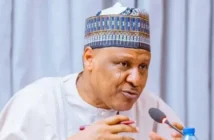
INEC Chairman, Joash Amupitan, disclosed the measures at a peace and security conference organised by the Goodluck Jonathan Foundation in Abuja. He was represented at the event by National Commissioner May Agbamuche-Mbu.
Amupitan acknowledged that the conduct of the 2023 general elections had created concerns about the commission’s credibility, noting that rebuilding public trust would require improved performance and transparency.
“We cannot strengthen trust without acknowledging that the 2023 general election left a significant trust deficit. Yet, trust is earned in execution,” he said.
He explained that INEC had used subsequent elections to identify operational shortcomings, improve its procedures and strengthen its capacity to conduct credible polls.
According to him, the commission conducted off-cycle governorship elections in Anambra, Ekiti and Osun states, elections into the Federal Capital Territory (FCT) area councils and 16 bye-elections within the preceding 13 months.
He described the elections as an opportunity to assess the commission’s performance, adding that INEC had been able to conclude polls and announce results within 24 hours.
“Over the past thirteen months, INEC has treated off-cycle governorship polls in Anambra, Ekiti, and Osun, the FCT area council elections, and sixteen bye-elections as a diagnostic laboratory—enabling us to conclude contests and declare results within twenty-four hours. Citizens demand predictability, transparency, and honesty,” he said.
The INEC chairman also disclosed that the commission had reviewed its electoral operations under the Electoral Act 2026 in preparation for the January 2027 general elections.
On voter registration, Amupitan said INEC had strengthened its Continuous Voter Registration exercise and deployed its Automated Biometric Identification System to audit the voters’ register.
He said the exercise led to the removal of more than 1.6 million invalid entries, leaving over 100 million verified voters on the register.
He added that the register currently includes 232,658 persons with disabilities, noting that the commission plans to expand the provision of assistive tools to improve their participation in the electoral process.
On election results transmission, Amupitan said INEC had upgraded its Election Results Viewing Portal (IReV) to introduce additional safeguards against errors and irregularities in polling unit results.
“Our upgraded IReV architecture automatically rejects polling unit figures (Form EC8A) failing arithmetic checks or reflecting over-voting, ensuring only verified results appear online,” he said.
He further announced that the commission had procured 57,000 new Bimodal Voter Accreditation System (BVAS) devices and established climate-controlled storage facilities across the country to protect its electoral equipment.
According to him, INEC had also reduced the number of registered voters assigned to each BVAS device from 1,250 to 850 to improve accreditation efficiency.
“Rather than deploying untested technology, we procured 57,000 new BVAS devices, built climate-controlled storage nationwide, and reduced the threshold from 1,250 to 850 voters per machine,” he stated.
Amupitan also announced that INEC would conduct a mock election on November 28 to test its electoral systems, identify potential challenges and address them before the 2027 general elections.
He stressed the importance of testing electoral technology ahead of major polls rather than introducing untested systems during elections.
The INEC chairman further warned that misinformation and disinformation could increase public anxiety, undermine confidence in electoral institutions and threaten peaceful elections.
He said the commission was expanding its real-time information verification channels through collaborations with the media, civil society organisations and the National Orientation Agency to ensure that accurate information reaches the public promptly.
“Because deliberate misinformation and disinformation manufacture panic and can trigger a breakdown of peace and order, INEC is expanding real-time verification channels with the media, civil society, and the National Orientation Agency so verified facts outpace falsehoods,” he said.