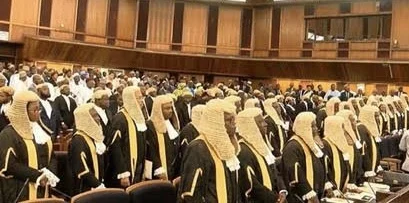
The inauguration ceremony was held on Monday at the Body of Benchers Auditorium in Abuja, alongside the unveiling of the second edition of the Judicial Electoral Manual and a specialised capacity-building workshop for judicial officers.
During the ceremony, Kekere-Ekun urged the newly inaugurated judges to uphold judicial independence, resist political interference and dispense justice without fear or favour.
Addressing the tribunal members, the CJN stressed the importance of complying with constitutional provisions, judicial ethics and the rule of law. She also warned political parties, legal practitioners, media organisations and members of the public against engaging in unethical activities capable of undermining the judicial process.
She particularly cautioned against the misuse of ex parte applications and coordinated online campaigns designed to influence pending court cases or intimidate judicial officers.
Kekere-Ekun emphasised that election petition matters must be determined strictly on the basis of evidence and relevant laws, rather than public opinion or political pressure. She also reminded the judges of the need to ensure effective case management and deliver judgments within the stipulated statutory timelines.
In her remarks, the President of the Court of Appeal, Justice Monica Dongban-Mensem, disclosed that the 375 judicial officers comprised 138 judges with previous election tribunal experience and 237 newly nominated members drawn from judicial institutions across the country.
Dongban-Mensem noted that the credibility of the electoral process depends significantly on the availability of impartial, efficient and timely mechanisms for resolving election disputes. She urged the judges to remain conscious of the public scrutiny that would accompany their responsibilities.
Meanwhile, the Chairman of the Independent National Electoral Commission (INEC), Professor Joash Amupitan, highlighted emerging technological challenges that could complicate election-related litigation in 2027.
He specifically identified artificial intelligence-generated deepfakes and disputes over the electronic transmission of election results as potential issues requiring attention.
Amupitan stressed the importance of strong collaboration between INEC and the judiciary to protect democratic institutions, address emerging electoral challenges and sustain public confidence in the electoral process.
The 2027 general elections are scheduled to begin with the Presidential and National Assembly elections on January 16, 2027, while the Governorship and State Houses of Assembly elections are slated for February 6, 2027.