The British government has confirmed it did not take part in the U.S.–Israeli strikes on Iran, as Prime Minister Keir Starmer convened an emergency meeting of the government’s Cobra committee to address the unfolding situation.
U.S. and Israeli forces launched attacks on Iran early Saturday, describing the operation as a “pre-emptive” move against what they said was a Tehran government pursuing nuclear weapons capabilities.
The strikes prompted retaliation from Iran, with missiles reportedly targeting Israel and several countries across the Middle East.
A government spokesperson said the UK did not want to see “further escalation into a wider regional conflict” and reaffirmed Britain’s support for a negotiated resolution to concerns over Iran’s nuclear ambitions.
Following the attacks, the Foreign, Commonwealth & Development Office advised against all travel to Israel, while British embassies in Bahrain, Qatar and the United Arab Emirates urged UK nationals to shelter in place.
The spokesperson added: “Iran must never be allowed to develop a nuclear weapon, which is why we have consistently supported efforts to secure a negotiated solution. Our immediate priority is the safety of UK nationals in the region, and we are providing consular assistance around the clock.”
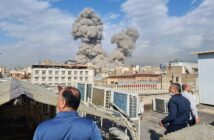
The United States and Israel began their operation with what appeared to be strikes near the offices of Iran’s Supreme Leader, Ali Khamenei. Iranian media reported attacks across the country, with smoke seen rising from the capital, Tehran.
In a video posted online, U.S. President Donald Trump said American forces had initiated “major combat operations in Iran.” He alleged that Iran had continued advancing its nuclear programme and was developing missiles capable of reaching the United States.
During a briefing, Israeli military spokesperson Lt. Col. Nadav Shoshani said Israel had observed “a sharp acceleration” in Iran’s missile development, claiming Tehran had begun producing dozens of ballistic missiles each month. He added that there had been no significant impacts inside Israel as of late morning, roughly four hours after the operation began.
Iran’s Supreme National Security Council later confirmed that its armed forces had “commenced a decisive response to these hostile acts.”