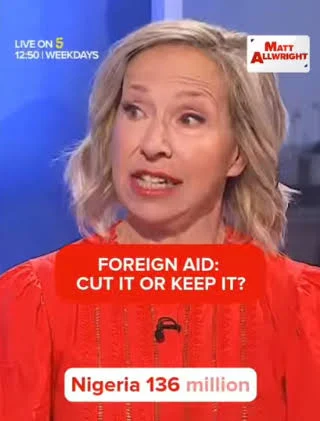
In a video that has gone viral, Turner, while speaking on a Channel 5 programme in the UK, challenged the rationale behind the £136 million reportedly allocated to Nigeria annually. She argued that the funds often fail to reach the ordinary citizens who need them most, alleging that high-level corruption undermines the impact of foreign aid.
Turner pointed to Nigeria’s reported population of wealthy individuals, including thousands of millionaires, and estimated annual losses of more than $15 billion to corruption. She questioned why the UK should continue providing financial assistance to a country where, she argued, public funds are not adequately accounted for.
She also highlighted the economic challenges facing the UK, noting that many hardworking British citizens are struggling to afford basic necessities such as food and energy bills. According to her, the government should prioritise addressing domestic concerns before committing millions of pounds to foreign aid.
“We currently give Nigeria £136 million a year. They have eight and a half thousand millionaires there, and they lose approximately $15 billion a year in corruption. So, we are giving money to a country that has a great number of wealthy people in it, and this money will be fuelling the corruption. So, I don’t think we should be giving them aid,” she said.
Turner further argued that foreign aid can encourage corruption in some countries and undermine their ability to develop independent economies.
“There is no doubt aid funnels corruption in certain countries. It also infantilises them. If you ask some people in African countries, they say, ‘We don’t want a white saviour complex. We want to be able to build our own economies,’” she added.
The journalist questioned why Nigeria should continue relying on financial assistance from foreign governments despite the wealth held by some of its citizens. She maintained that the UK government has a primary responsibility to address the needs of its own population.
Her remarks have since sparked debate online, with the discussion reigniting broader questions about foreign aid, corruption, accountability and the responsibility of governments to prioritise their citizens.