The Nigerian Communications Commission (NCC) has approved a tariff increase for telecommunications companies in the country.
This announcement was made by Reuben Mouka, the commission’s spokesperson, who explained that the approval was granted under Section 108 of the Nigerian Communications Act, 2003 (NCA), which empowers the NCC to regulate and approve tariff rates for telecom operators. According to Mouka, the tariff adjustment, capped at a maximum of 50 percent of current rates, is lower than the over 100 percent increase requested by some operators. The decision was made after considering ongoing industry reforms aimed at enhancing sustainability.
He clarified that the approved tariff adjustments would stay within the limits set by the 2013 NCC Cost Study, with each request being reviewed individually, as is customary in tariff reviews. The adjustments will be implemented in line with the recently issued NCC Guidance on Tariff Simplification, 2024.
Mouka highlighted that telecom tariffs have remained unchanged since 2013, despite rising operational costs for telecom operators. The adjustment is intended to address the widening gap between operational expenses and current tariff rates while ensuring the continued delivery of services to consumers.
The new tariff structure is expected to help operators maintain their ability to invest in infrastructure and innovation, ultimately benefiting consumers with better services, improved network quality, enhanced customer support, and broader coverage.
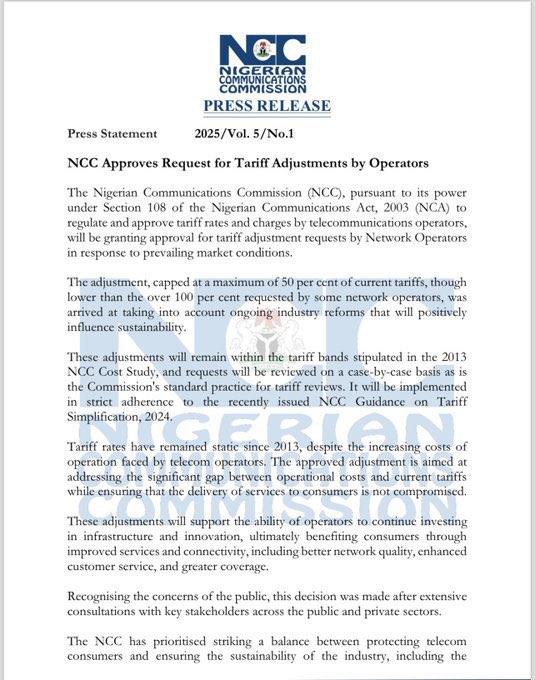
Acknowledging public concerns, Mouka emphasized that the decision followed extensive consultations with key stakeholders from both the public and private sectors. The NCC is committed to balancing consumer protection with ensuring the industry’s sustainability, including the thousands of local vendors and suppliers vital to the telecommunications ecosystem.
The NCC also recognizes the financial pressures faced by Nigerian households and businesses and is dedicated to minimizing the impact of tariff changes. To that end, operators are required to implement the tariff adjustments transparently and fairly, while educating the public on the new rates and demonstrating improvements in service delivery.
Furthermore, the NCC reaffirmed its commitment to fostering a resilient, innovative, and inclusive telecommunications sector. The Commission’s efforts aim not only to protect consumers but also to ensure the long-term growth of the industry, support local vendors and suppliers, and drive the development of Nigeria’s digital economy.
As part of its regulatory role, the NCC will continue engaging with stakeholders to create a telecom environment that benefits all parties—protecting consumers, supporting operators, and sustaining the ecosystem that enables nationwide connectivity.