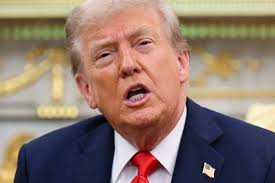
U.S. President Donald Trump has reiterated his call for the United States to annex Greenland, declaring that any alternative would be “unacceptable.”
Restating his long-held view that the move is vital to U.S. national security, Trump said NATO “should be leading the way” in securing Greenland for American control, arguing that the alliance would become “far more formidable and effective” if the territory were under U.S. authority. His comments came hours before high-level discussions involving U.S., Danish, and Greenland officials.
Denmark’s Foreign Minister Lars Løkke Rasmussen and Greenland’s Foreign Minister Vivian Motzfeldt met with U.S. Vice President J.D. Vance and Secretary of State Marco Rubio at the Eisenhower Executive Office Building. The 90-minute meeting did not include Trump, and Danish and Greenland officials were expected to brief the media afterward at Denmark’s embassy in Washington.
As the talks were underway, the White House shared a cartoon-style image on social media depicting a dog sled carrying the Greenland flag at a crossroads—one path leading to a bright White House, the other toward storm clouds labeled China and Russia. The caption read: “Which way, Greenland man?”
Despite growing pressure from Washington, Greenland has firmly rejected the idea of U.S. control. In a strong response, Greenland’s Prime Minister Jens-Frederik Nielsen said the territory would side with Denmark if forced to choose.
“We are now facing a geopolitical crisis, and if we have to choose between the United States and Denmark here and now, we choose Denmark,” Nielsen said, adding that Greenland stands with NATO, the Kingdom of Denmark, and the European Union. He has repeatedly urged Trump to abandon annexation rhetoric, warning that it amounts to pressure and disrespect. European leaders have echoed this stance, emphasizing that decisions about Greenland rest solely with Denmark and Greenland.
Criticism has also come from within Trump’s own Republican Party, where lawmakers have cautioned that pressuring a NATO ally risks damaging long-standing relationships without delivering clear strategic gains.
Greenland’s significance stems from its strategic Arctic location between North America, Europe, and Russia, making it crucial for military surveillance and defense. While the island already hosts a U.S. military base, Trump has argued that a larger American presence is necessary, citing increased Russian and Chinese activity in the region.
In addition to its strategic position, Greenland’s vast reserves of rare earth minerals have drawn U.S. interest, with officials saying the resources align with America-first economic and security objectives.