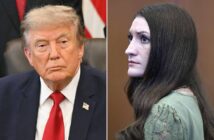
U.S. President Donald Trump’s sweeping tariffs on dozens of countries officially came into effect early Wednesday, shortly after the president claimed that foreign leaders were “calling us up, kissing my a–” in efforts to negotiate trade deals.
The tariffs, which impact around 90 countries, are expected to drive up import costs, leading to higher prices for American consumers on a range of goods. China faces the heaviest toll, with a cumulative tariff rate of 104 percent. Other countries such as Lesotho (50 percent) and Cambodia (49 percent) are also significantly affected.
U.S. Customs and Border Protection (CBP) confirmed that enforcement began at 12:01 a.m. on April 9. “CBP is uniquely positioned to implement and enforce the President’s tariffs using all our enforcement and revenue collection authorities,” the agency said in a statement.
The global market reacted sharply. Japan’s Nikkei index dropped by 3.8 percent, Taiwan’s stock market fell by 6 percent, South Korea’s currency sank to its lowest value since 2009, and Indonesia’s rupiah hit an all-time low.

Fitch Ratings warned of broader economic consequences, suggesting that while the tariffs could reduce the U.S. budget deficit in 2025, their negative impact on economic growth and tax cuts may negate any long-term fiscal benefits.
Despite the global market turmoil, Trump defended the tariffs during a speech at the National Republican Congressional Committee (NRCC) dinner in Washington, D.C., describing them as “legendary” and a key element of his economic strategy.
“Countries are calling us up, begging to make deals,” Trump told the audience. “They’re kissing my a–, they really are. They’re desperate to make a deal.”
Trump also expressed confidence in his second term, claiming that his approach to tariffs would exceed the success of his first. “This time I’m doing what I want with the tariffs,” he stated, referring to the new trade measures as “the largest transaction in the history of our country.”
The president also took aim at Republican critics who had questioned his executive-led approach to trade, remarking, “I see some grandstanding Republicans saying, ‘Congress should take over negotiations.’ Let me tell you, you don’t negotiate like I negotiate.”
The White House has offered mixed signals about the long-term nature of the tariffs. While Trump indicated on Monday that the tariffs could either be permanent or open to negotiation, Treasury Secretary Scott Bessent told CBS News that the tariffs were “negotiable but not a negotiating tactic.”
White House Press Secretary Karoline Leavitt emphasized that “the president will talk to any country that picks up the phone,” suggesting that the administration has received numerous requests for dialogue. However, Politico reported that several world leaders are still waiting for responses to their requests for talks with the U.S. administration.
Trump reiterated his long-standing narrative about the U.S. being exploited in global trade, stating, “Many countries have ripped us off left and right. Now it’s our turn to do the ripping. We’re going to make our country even stronger—stronger than it ever was.”
While the president remains optimistic, Wall Street appears more cautious. The Wall Street Journal noted a “gloomy” investor sentiment, with the S&P 500 falling 1.6 percent and the Nasdaq Composite dropping 2.2 percent. All three major indexes are now trading at their lowest points since early 2024.
Since declaring a national emergency and implementing the new tariffs last week, the Trump administration has sought to downplay concerns over potential economic fallout, asserting that any short-term disruptions will ultimately lead to long-term benefits.