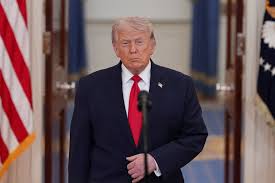
US President Donald Trump has announced that the United States will escalate its military campaign against Iran over the next two to three weeks, even as the conflict approaches its final phase.
In his first national address since the war began on February 28, Trump told Americans that the US-Israeli offensive is close to achieving its objectives.
“Thanks to the progress we’ve made, I can say tonight that we are on track to complete all of America’s military objectives shortly, very shortly,” he stated from the White House.
He added that while the war’s “core strategic objectives are nearing completion,” the US will continue to strike Iran forcefully in the coming weeks. “We are going to hit them extremely hard over the next two to three weeks,” Trump emphasized.
The president also reassured regional allies—including Israel, Saudi Arabia, Qatar, the United Arab Emirates, Kuwait, and Bahrain—that the United States would continue to support and protect them amid ongoing Iranian missile and drone attacks.
Trump suggested that diplomatic engagement with Iran’s new leadership could still be possible, describing them as “less radical and much more reasonable” than before. However, he warned that if no agreement is reached, the US is ready to target critical Iranian infrastructure, including electricity generation facilities.
Energy markets remained volatile following the speech, with oil prices rising due to concerns over the closure of the Strait of Hormuz, a key passage for roughly one-fifth of global oil supply. Iran’s Revolutionary Guards have pledged to keep the waterway closed to what they term “enemy nations.”
Iran rejected US ceasefire overtures, labeling Washington’s demands as “maximalist and irrational,” and denied engaging in direct negotiations, although indirect communications have reportedly occurred. Trump claimed that Iran’s president had sought a ceasefire but insisted that reopening the Strait of Hormuz was a prerequisite.
The conflict, which began with large-scale US and Israeli airstrikes on Iran, has sparked global economic uncertainty and heightened diplomatic tensions.
Ahead of Trump’s address, Iran’s President Masoud Pezeshkian appealed to the American public, questioning whether the war aligns with the “America First” agenda, accusing Washington of war crimes, and emphasizing that ordinary Americans are not Iran’s enemies.
Hostilities continued across the region, with Iran launching new missile and drone attacks on Israeli cities, including Tel Aviv and Eilat, as well as US military bases in the Gulf. Israeli authorities reported activating air defence systems to intercept the incoming threats.
As Israel observed the start of the Passover holiday, air raid sirens sounded in several areas. A missile strike injured 14 people, including an 11-year-old girl.
The Iranian Revolutionary Guards also claimed responsibility for hitting an oil tanker off the coast of Qatar, reportedly linked to Israel. The vessel sustained damage, but no casualties were reported.