Peter Obi, the Labour Party’s Presidential candidate in the 2023 election, has urged the Nigerian Government to urgently address the ongoing crisis at the University of Calabar (UNICAL) concerning the graduation and induction quota for dental students.
UNICAL is currently facing a serious credibility crisis after it was revealed that the university admitted significantly more dental students than the quota approved by the Medical and Dental Council of Nigeria (MDCN). Investigations showed that UNICAL admitted up to 90 dental students annually, despite only having provisional accreditation for 10 students per year. The MDCN, which regulates medical and dental education and practice in Nigeria, has refused to verify graduation lists that exceed the approved quota.
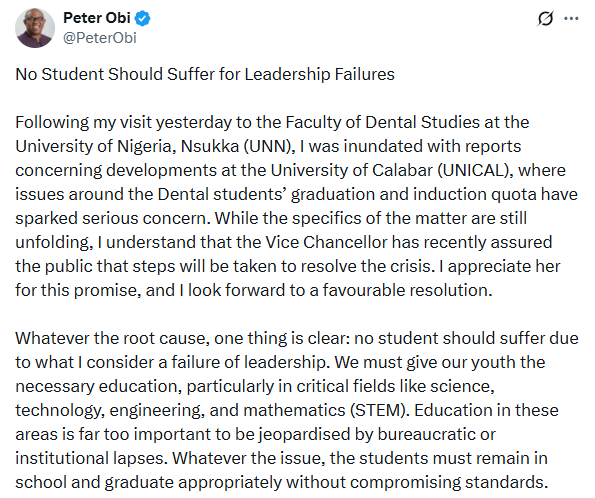
In a statement posted on his X handle on July 19, Obi expressed deep concern over the situation, describing it as a failure of leadership. He emphasized that no student should suffer due to the lapses of those in charge and stressed the importance of resolving the matter so students can graduate on schedule.
“No student should suffer for leadership failures,” Obi stated.
Following his recent visit to the Faculty of Dental Studies at the University of Nigeria, Nsukka (UNN), Obi said he was inundated with reports about the crisis at UNICAL. While the details are still emerging, he acknowledged the Vice Chancellor’s assurance that steps are being taken to resolve the issue and expressed hope for a positive outcome.
He stressed the critical importance of education, especially in STEM fields, and insisted that bureaucratic or institutional failings should never jeopardize students’ futures. “Whatever the issue, the students must remain in school and graduate without compromising standards,” he said.
Obi drew on his own experience as former Governor of Anambra State, recounting how he dealt with a similar challenge when the Medical and Dental Council of Nigeria shut down the medical school at Chukwuemeka Odumegwu Ojukwu University due to the absence of a teaching hospital—a key accreditation requirement. Students who had already spent years studying medicine were at risk of graduating only in other science disciplines.
“I had just assumed office when the crisis hit, but I refused to let those students suffer. I pleaded with the Council, insisting that the children were not to blame and should not bear the consequences. I promised to take full responsibility and committed to building a teaching hospital within two years,” Obi recalled.
Despite skepticism, Obi delivered on that promise in less than 18 months by building and commissioning the Odumegwu-Ojukwu Teaching Hospital in Awka, preserving the medical faculty’s accreditation and safeguarding the futures of aspiring doctors.
Calling on the Federal Government to act decisively, Obi urged that financial and institutional support be provided to the University of Calabar’s leadership. “The Vice Chancellor and her team must be empowered to resolve this crisis immediately to ensure no student suffers for circumstances beyond their control,” he said.
Obi warned that Nigeria cannot continue to neglect education and healthcare or fail to lift citizens out of poverty while wasting resources on unproductive areas. “Our children must not continue to lose their future in Nigeria,” he declared.
“A New Nigeria is Possible.”