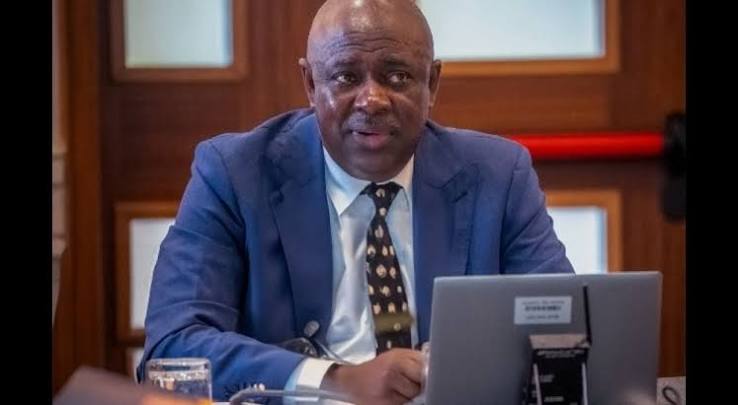
The Minister of State for Petroleum Resources (Oil), Heineken Lokpobiri, has said the average price of petrol in Nigeria remains lower than in the United States and some other African countries despite the removal of fuel subsidy.
Lokpobiri made the claim during an appearance on Channels Television’s Politics Today on Tuesday, September 22, while defending the Federal Government’s deregulation of the downstream petroleum sector amid concerns over rising petrol prices.
According to the minister, petrol currently sells for an average of N1,430 per litre in Nigeria, compared with N1,633 in the United States, N1,959 in Cameroon, and N2,070 in both Ghana and South Africa.
“In the US, the average, you know, litre of fuel is N1,633. In Nigeria, it’s on the average of N1,430. If you go to Cameroon, it’s N1,959. If you go to Ghana, it’s N2,070. If you go to South Africa, it’s N2,070,” Lokpobiri said.
His comments came amid recent reductions in depot prices by the Dangote Petroleum Refinery and other fuel marketers following a decline in international crude oil prices.
Dangote Refinery cut its petrol depot price from N1,350 to N1,325 per litre, while other marketers also reduced prices across depots in Lagos, Port Harcourt, Calabar and Warri. Despite the reductions, retail prices remained considerably higher than depot prices in several locations, with recent checks putting petrol at around N1,430 per litre in major cities.
Lokpobiri argued that being an oil-producing country and having a major domestic refinery does not automatically mean Nigeria should have cheaper petrol.
He cited the United States, which he described as the world’s largest oil and gas producer with extensive refining capacity, noting that petrol prices there could still be higher than in Nigeria.
The minister stressed that crude oil and refined petroleum product prices are influenced by global markets, saying Nigeria cannot operate independently of international energy prices.
“Oil and gas is a global commodity. What is sold in New York is what is also sold here,” he said, adding that consumers in the US and Europe were also dealing with the impact of high energy costs.
Lokpobiri also defended the deregulation of the downstream petroleum sector, arguing that the policy had created room for greater private-sector investment.
He said the Dangote Refinery would have struggled to compete if the Federal Government had continued importing petrol and selling it below market prices through subsidies.
“But for the policy of deregulation, Dangote Refinery wouldn’t have been the most attractive IPO in the continent,” he said. “If government was continuously importing, as NNPC was doing, and selling at a lower price than the market price, Dangote wouldn’t have been able to survive.”
According to the minister, deregulation was designed to encourage greater private-sector participation in Nigeria’s midstream and downstream oil and gas industries.
He also defended the removal of petrol subsidy, saying it had increased funds available for distribution to the federal, state and local governments through the Federation Account Allocation Committee (FAAC).
Lokpobiri said about N2.1 trillion is currently being shared, allowing state governments to meet their financial obligations and undertake major projects.
He maintained that the Federal Government would not reverse the deregulation policy despite pressure from consumers, arguing that a return to controlled petrol prices would effectively require the reintroduction of subsidies.
The minister further cited increased domestic refining, the supply of aviation fuel by the Dangote Refinery and earnings from the oil and gas sector as signs of developments in the industry.
He maintained that oil and gas remains Nigeria’s major source of foreign exchange earnings and said continued deregulation was necessary to attract further private investment into the sector.